
-
Monday:
N/A
---
Tuesday:
ADP Employment Change
---
Wednesday:
FOMC Minutes
---
Thursday:
Existing Home Sales (4.2M exp.)
Initial Jobless Claims (220K exp.)
---
Friday:
N/A
-
Monday:
N/A
---
Tuesday:
N/A
---
Wednesday:
N/A
---
Thursday:
Pepsico, Inc.
---
Friday:
Delta Air Lines, Inc.
Hyperscalers On Sale
Got a question about the markets, your investments, or a topic you’d like us to discuss in an upcoming article? We read every message and may feature your question in our daily write-ups!
Email: andrei@signal-sigma.com
Follow & DM on X: @signal_sigma
Last week was a holiday shortened one, with the market being closed on Friday to mark the Fourth of July. The S&P 500 managed to add about +2% and close near 7,537 by Monday evening. Overall, Q2 2026 was the best quarter in 6 years, with a +13% return for SPY. Of course, the performance closely aligns with the bottom in the Middle East conflict, which happened around March 30. Since then, it has been a straight line up, with little reprieve.
Economic data included a June payrolls print on Thursday which showed just 57K jobs added, well short of the 115K prognosis. The unemployment rate slipped to 4.2%, with the cumulative Initial and Continuing Claims remaining subdued. The miss on payrolls reignited hopes for a rate cut to a certain extent and helped lift the main indices, as the Dow closed at a record.
As a result, the 10-yr Treasury yield sits near 4.5% and the curve has a positive slope, so the recession signals the bears keep waiting for have simply not shown up. This did not stop Michael Burry from posting bearish comments on the AI trade all week long.
To a certain extent, it seems like the market is exhausted with the narrative as well. A clear rotation is underway, with mega caps bouncing hard and semiconductors cooling.
On the week, the Momentum Factor ETF (MTUM) was the clear loser, while MGK rose +4.8%. This speaks of a fundamental rotation from AI Capex beneficiaries to AI Capex spenders. While Apple rose +9%, semiconductors (SMH) fell -4%. Several memory names were down -8% or more. Samsung’s recent beat did not help alleviate fears, with the stock declining even after profits came in 19x higher than last year. Earnings season will decide where we go next. In any case, the Mag 7 lineup deserves a closer look, especially from a valuation perspective.
The market’s largest growth names, Apple (AAPL), Microsoft (MSFT), Google (GOOG), Amazon (AMZN), Tesla (TSLA), Meta (META), and Nvidia (NVDA), have trailed badly during the past month. The bearish story has a name: CAPEX (capital expenditures). The companies which set out to spend the most on AI infrastructure got penalized with sharp selling.
A valuation gap is becoming apparent. The average Price / Sales for the whole group now sits at 10.4 versus a 19.2 all time high in the last 10 years. That is a -45% discount, which is uncommon for some of the most hyped stocks in the US market.
Over the past year, combined Mag 7 performance has been basically on par with that of SPY, especially given the recent sharp decline. This was not the whole group falling together. Microsoft is down roughly 22% this year and just closed its worst month since 2000. Meta is off about 14% over six months. Yet Alphabet is up around 12%, with Apple and Nvidia also higher. So is there a real problem under the surface or is this just a narrative shift?
Evidence shows that capital did not leave the market. It rotated from those who do the spending (hyperscalers) to those that are the recipients of said spending (semiconductors and memory stocks, collectively represented by the SMH ETF).
There is one inconsistency worth pointing out: for years, no one complained when these mega caps spent billions on share buybacks. A buyback does nothing for the underlying business. Yet it does return cash to shareholders via artificially inflated EPS, which is all but guaranteed to drive the stock price higher. The market likes and rewards companies engaged in buybacks — because the outcome is certain.
With AI infrastructure spending, the outcome is far less certain. As companies direct cash into server capacity and data centers, the market recoils. The return on the cost of capital expenditures related to AI is not 100% clear. There is a fair amount of skepticism whether the whole investment will ever pay off at all given the unprecedented scale.
However, from 2016 to 2020, the same companies poured cash into data centers to build out the cloud. There was the same concern related to runaway spending and unsustainable margins. Yet since 2016, Mag 7 revenues jumped +375% versus +95% for the average S&P 500 stock. The investment (although uncertain at the time, like with any investment) did pay off handsomely.
Another interesting dynamic — the price correction within the Mag 7 cohort happened on the backdrop of rising earnings, not falling ones.
Which brings us to today’s market. Have Mag 7 stocks completely repriced the CAPEX risk? Because if so, then the most likely direction for this influential group of stocks is up. And given that they make up roughly 30% of the S&P 500, their next leg in the market will dictate where the most influential index goes next. The options market says this is one of the best times to invest in large caps, as the long term upside dwarfs medium term downside.
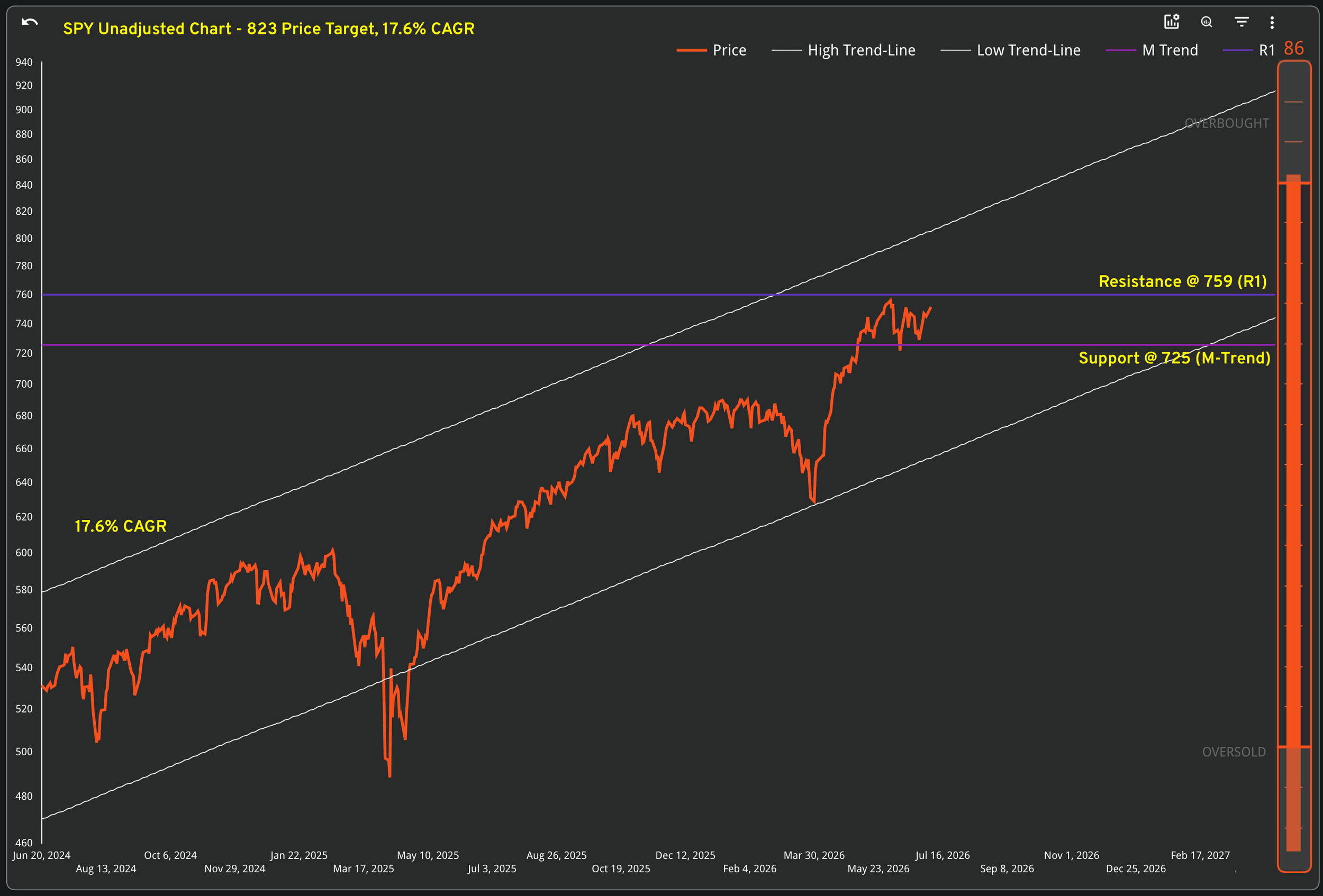
Which brings us to the market. If indeed our analysis is correct, SPY’s next leg will likely imply upside rather than downside. Resistance stands at $759 (R1), with support at $725 (M-Trend). Yesterday was a day of accumulation in Dark Pools. The Buying Regime is positive after some intermittent breaks. Sentiment is far from being stretched to extremes, with AAII bulls near the lowest level in at least a year.
This is a neutral market in consolidation and rotation mode, coling in preparation of a larger jump. The fuel will most likely be found during Q3 Earnings Season, where the mega caps will provide leadership.
Our Trading Strategy (Sigma Portfolio)
As was noted in the article, we will also rotate away from small and more speculative companies, to larger cap and more quality names. Growth is still the name of the game, so we are not abandoning the theme entirely. Just changing which kind of growth we’d like to pursue.
Our Enterprise strategy has chosen to allocate risk in the commodities asset class for the week. The play in DBC is essentially a buy the dip technical move, and does not represent a risk-off approach. On the contrary, commodities are definitely a risk-on trade, with the potential to hedge future geopolitical uncertainty.
Disclosures / Disclaimers: This is not a solicitation to buy, sell, or otherwise transact any stock or its derivatives. Nor should it be construed as an endorsement of any particular investment or opinion of the stock’s current or future price. To be clear, I do not encourage or recommend for anyone to follow my lead on this or any other stocks, since I may enter, exit, or reverse a position at any time without notice, regardless of the facts or perceived implications of this blog post. I currently do not own or plan to own any position, long or short, in the securities mentioned.
I am not a financial advisor licensed in the United States. Nor am I providing any recommendations, price targets, or opinions about valuation regarding the companies discussed herein. Any disclosures regarding my holdings are true as of the time this article is written, but subject to change without notice. I frequently trade my positions, often on an intraday basis. Thus, it is possible that I might be buying and/or selling the securities mentioned herein and/or its derivative at any time, regardless of (and possibly contrary to) the content of this blog post.
I undertake no responsibility to update my disclosures and they may therefore be inaccurate thereafter. Likewise, any opinions are as of the date of publication, and are subject to change without notice and may not be updated. I believe that the sources of information I use are accurate but there can be no assurance that they are. All investments carry the risk of loss and the securities mentioned herein may entail a high level of risk. Investors considering an investment should perform their own research and consult with a qualified investment professional.
I wrote this blog post myself, and it expresses my own opinions. I do not have a business relationship with any company whose stock is mentioned in this blog post. The information in this blog post is for informational purposes only and should not be regarded as investment advice or as a recommendation regarding any particular security or course of action.
The primary purpose of this blog post is to share industry expertise and research and receive feedback (confirmation / refutation) regarding my investment theses.