
/ August 31 / Weekly Preview
-
Monday:
N/A
---
Tuesday:
ISM Manufacturing PMI (55.3 exp.)
JOLTs Job Openings (7.39M exp.)
---
Wednesday:
N/A
---
Thursday:
Initial Jobless Claims (205K exp.)
ISM Services PMI (54.1 exp.)
---
Friday:
Non Farm Payrolls (45K exp.)
Unemployment Rate (4.2% exp.)
-
Monday:
N/A
---
Tuesday:
Palo Alto Networks, Inc.
Dell Technologies Inc.
---
Wednesday:
Broadcom Inc.
Snowflake Inc.
NetApp, Inc.
Argan, Inc.
---
Thursday:
Ciena Corporation
lululemon athletica inc.
DocuSign, Inc.
---
Friday:
N/A
Cracks Show Up Again
Got a question about the markets, your investments, or a topic you’d like us to discuss in an upcoming article? We read every message and may feature your question in our daily write-ups!
Email: andrei@signal-sigma.com
Follow & DM on X: @signal_sigma
Last week, the headlines belonged to the bulls. The S&P 500 closed Friday at 7,711.76, up +0.5% on the week, and the Nasdaq Composite added +0.9% to 26,402.42. The internals told another story, however. The average stock lost ground: the equal-weight S&P slipped -0.4% even as the cap-weighted index rose, and the Russell 2000 fell about -1.4%. Only three of the twelve sectors finished in the green.
Nvidia did the heavy lifting. Its blowout Wednesday-night report and a forecast of 70% revenue growth in fiscal 2028 sent the stock up nearly +9% on Thursday and pulled the index to a fresh record before Friday’s fade. The entire bullish narrative is now leaning on the AI complex, and the AI complex is leaning on one data point call at a time. Communication services (XLC), technology (XLK), and financials (XLF) were the only sectors to advance. Health care (XLV), industrials (XLI), and energy (XLE) led the laggards.
Over the weekend, Kevin Warsh gave his first Jackson Hole address and reiterated his stance: “no forward guidance” remains intact. He said that the summer’s softer inflation prints are not especially meaningful and his commitment is to discipline rather than a particular decision. At the moment, the market is split between a pause (38%) and a hike (62%) at the September meeting, so it’s still a toss-up.
Beneath the relative calm of the equity markets, bonds have seen their share of volatility, especially at the long end. The 30-year sits at 5.2%, not far from a 19 year high. This comes even after the announcement from the Treasury that they will double long-dated buybacks to 4B starting September 4th.
Cross-asset returns reflected a cautious narrative. On Friday, gold dropped -2.9% to about $4,530 after its best month in decades, WTI traded around $83, and bitcoin eased toward $77,700 as the mid-month squeeze unwound. The underlying issue is uncertainty about whether the Fed can effectively transmit its interest-rate signal to bond markets.
At present, our Enterprise asset-allocation strategy maintains a risk-on stance that has performed well in 2026. The model has recently shifted to an equity weighting above 80%, reflecting the maximum permitted risk allocation. Technicals have, so far, confirmed this stance.
SPY remains a smidge below all-time-high values, but underlying momentum has quietly rolled over. The benchmark ETF stands 2% above its rising 50-DMA, with 1.1% separating it from a new record. The longer term trend is positive, and so is the weekly MACD. No issues from a medium term perspective then, this remains a bull market through and through.
Some cracks are appearing in market breadth, and we’ll study that in a minute. The short term MACD is negative, with the histogram also printing negative. We’ll interpret this as a loss of upside thrust, not necessarily the start of a breakdown. Price near the highs on fading momentum is how short consolidation and pauses begin (occasionally, larger drawdowns also start this way).
Resistance stands at all-time-highs ($777) followed by $788 at the R1 level. We’ll treat the 50-DMA and M-Trend cluster ($750) as the line in the sand between bullish and bearish developments. Any break of the 50-DMA is the level that begins to turn the recent pause into something worth hedging.
Though we have not recorded an actual sell signal in any of our studies, an abrupt drop in participation has us slightly cautious. The number of stocks trading above their 20-DMAs has dropped to 43% from recent highs of more than 70%.
When generating signals that fire on similar drops in the past, we actually get an extremely bullish signal - but there’s a catch! These drops tend to be buying opportunities only while the overall level of 20-DMA breadth is lower than 40% — which is not the case today. As such, the slowing momentum becomes a concern.
Heading into the week, the labor market will effectively provide answers to most questions at once. The August employment report arrives Friday at 8:30 a.m. ET and serves as the week's pivot. After the Fed chair declined to commit to a September rate cut, a weak payrolls print would embolden the doves, while a strong reading paired with persistent inflation would justify keeping rates steady and maintain pressure on longer-term yields.
But Friday isn’t the only market mover. Tuesday brings JOLTS job openings and the ISM Manufacturing index, with attention focused on the prices-paid subcomponent after it recently topped 70.
Wednesday’s ADP private payrolls—which have tended to run soft—should offer clues ahead of Friday’s BLS report. Thursday brings ISM Services, weekly jobless claims, the trade balance, and productivity revisions into a single busy session as September gets underway.
The Fed also goes dark, as the pre-FOMC blackout period begins. On the AI trade, Broadcom (AVGO) will give us a read on whether hyperscaler AI capex is still accelerating.
From an options market perspective, the market’s long term upside has expanded to levels which are similar to the April washout lows. Medium term risk is priced lower than at the mid-August peak.
Given that we are still trading in a well defined buying regime, breadth concerns are not enough to warrant a reduction in exposure at the moment.
Yes, the market was mixed this past week, but still managed a modest gain. Technology advanced on Nvidia’s earnings, while Energy slipped as oil prices fell. Communications is the most overbought sector, and Industrials, Utilities, and Small- and Mid-cap stocks are the most oversold short term.
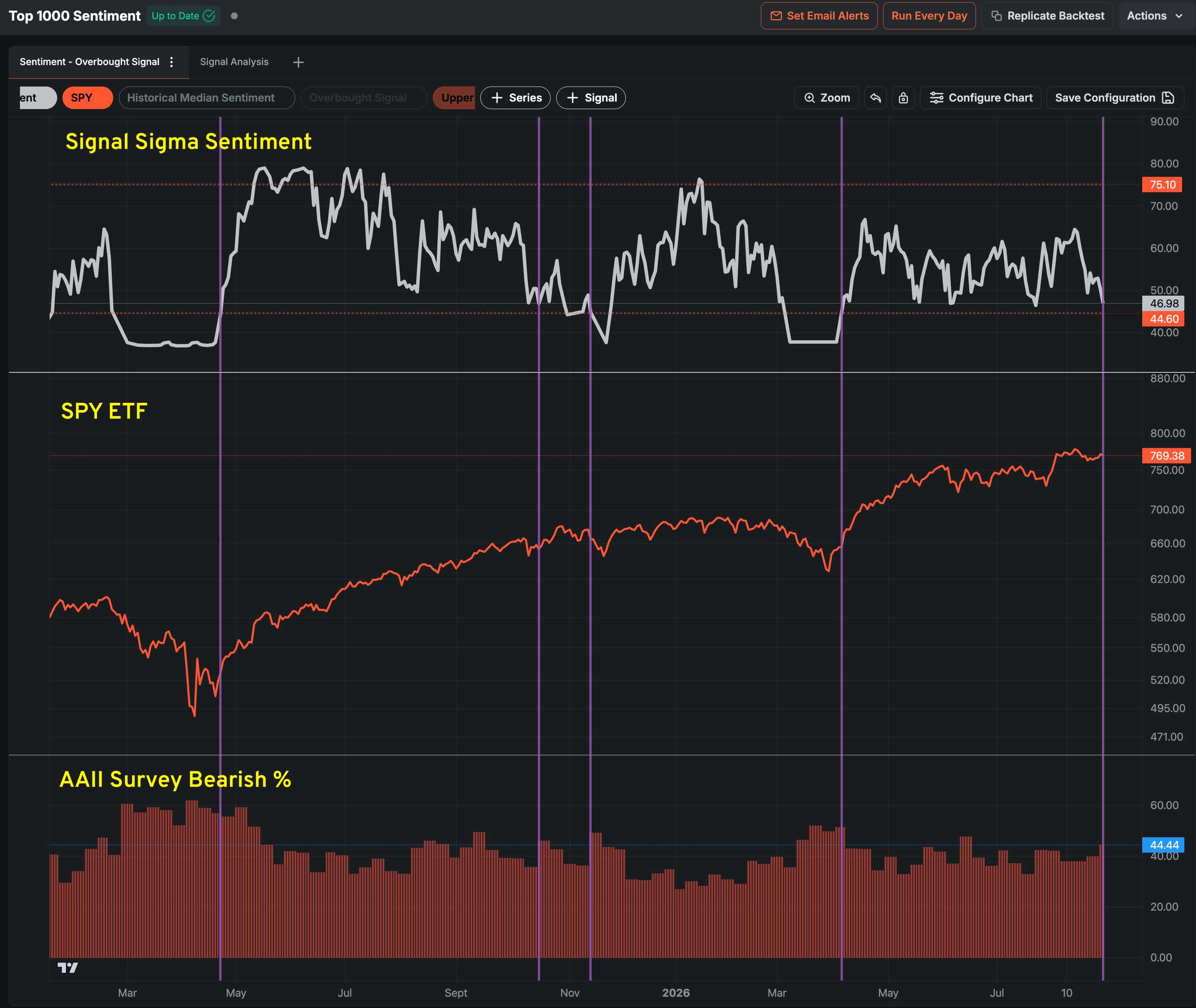
From a sentiment perspective, we’re recording unusually bearish conditions given that the market is close to all time highs and investors should still be looking at positive p/l values in their portfolios. Yet the environment doesn’t “feel” positive, with all of the inflation and war related headlines (nevermind the AI-bubble fear theme).
Similar “mildly bearish” scenarios in the past (Signal Sigma Sentiment between 44-47 AND AAII Bearish Sentiment > 44%) have a good track record of resolving to the upside with significant outperformance (twice the median performance at the 1 and 3-Month intervals).
The fly in the ointment is seasonality. September in midterm years has historically been a weak month for the S&P 500, with an average price return of about -1.1% across midterm cycles since 1942 (positive just 48% of the time). September is the only month with a negative long-term average, and midterm-year uncertainty has often amplified the usual seasonal softness. Over the last 10 midterm years seasonality has been a bit worse, averaging roughly -2%, with 6 down months and 4 up months.
Our Trading Strategy (Sigma Portfolio)
At this particular junction, the market does not offer either a compelling breakout case (where we would add exposure on higher highs), nor does it warrant buying a dip (since there is no dip to be bought). As it stands, the overall regime continues to be bullish and our 66% exposure to stocks is warranted.
However, there’s no need to make any adjustment right now. We’ll allow Enterprise to conduct its weekly rebalancing tomorrow and go from there. If seasonality does bring a -2% dip that does not violate the 50-DMA, then we’d find that a good entry point to add for a year-end rally.
As usual, we’ll keep you informed via Trade Alerts.
Disclosures / Disclaimers: This is not a solicitation to buy, sell, or otherwise transact any stock or its derivatives. Nor should it be construed as an endorsement of any particular investment or opinion of the stock’s current or future price. To be clear, I do not encourage or recommend for anyone to follow my lead on this or any other stocks, since I may enter, exit, or reverse a position at any time without notice, regardless of the facts or perceived implications of this blog post. I currently do not own or plan to own any position, long or short, in the securities mentioned.
I am not a financial advisor licensed in the United States. Nor am I providing any recommendations, price targets, or opinions about valuation regarding the companies discussed herein. Any disclosures regarding my holdings are true as of the time this article is written, but subject to change without notice. I frequently trade my positions, often on an intraday basis. Thus, it is possible that I might be buying and/or selling the securities mentioned herein and/or its derivative at any time, regardless of (and possibly contrary to) the content of this blog post.
I undertake no responsibility to update my disclosures and they may therefore be inaccurate thereafter. Likewise, any opinions are as of the date of publication, and are subject to change without notice and may not be updated. I believe that the sources of information I use are accurate but there can be no assurance that they are. All investments carry the risk of loss and the securities mentioned herein may entail a high level of risk. Investors considering an investment should perform their own research and consult with a qualified investment professional.
I wrote this blog post myself, and it expresses my own opinions. I do not have a business relationship with any company whose stock is mentioned in this blog post. The information in this blog post is for informational purposes only and should not be regarded as investment advice or as a recommendation regarding any particular security or course of action.
The primary purpose of this blog post is to share industry expertise and research and receive feedback (confirmation / refutation) regarding my investment theses.