
/ February 09 / Weekly Preview
-
Monday:
Fed Speakers
---
Tuesday:
ADP Employment Change
Retail Sales MoM (0.4% exp.)
---
Wednesday:
Non Farm Payrolls (70K exp.)
Unemployment Rate (4.4% exp.)
---
Thursday:
Initial Jobless Claims (218K exp.)
---
Friday:
Core Inflation Rate YoY (2.5% exp.)
Inflation Rate YoY (2.5% exp.)
-
Monday:
Apollo Global Management, Inc.
ON Semiconductor Corporation
---
Tuesday:
AstraZeneca PLC
Coca-Cola Company (The)
Gilead Sciences, Inc.
---
Wednesday:
Cisco Systems, Inc.
McDonald's Corporation
Shopify Inc.
Applovin Corporation
---
Thursday:
Applied Materials, Inc.
Arista Networks, Inc.
Vertex Pharmaceuticals Incorporated
---
Friday:
Enbridge Inc
NatWest Group plc
Softwaremageddon
Got a question about the markets, your investments, or a topic you’d like us to discuss in an upcoming article? We read every message and may feature your question in our daily write-ups!
Email: andrei@signal-sigma.com
Follow & DM on X: @signal_sigma
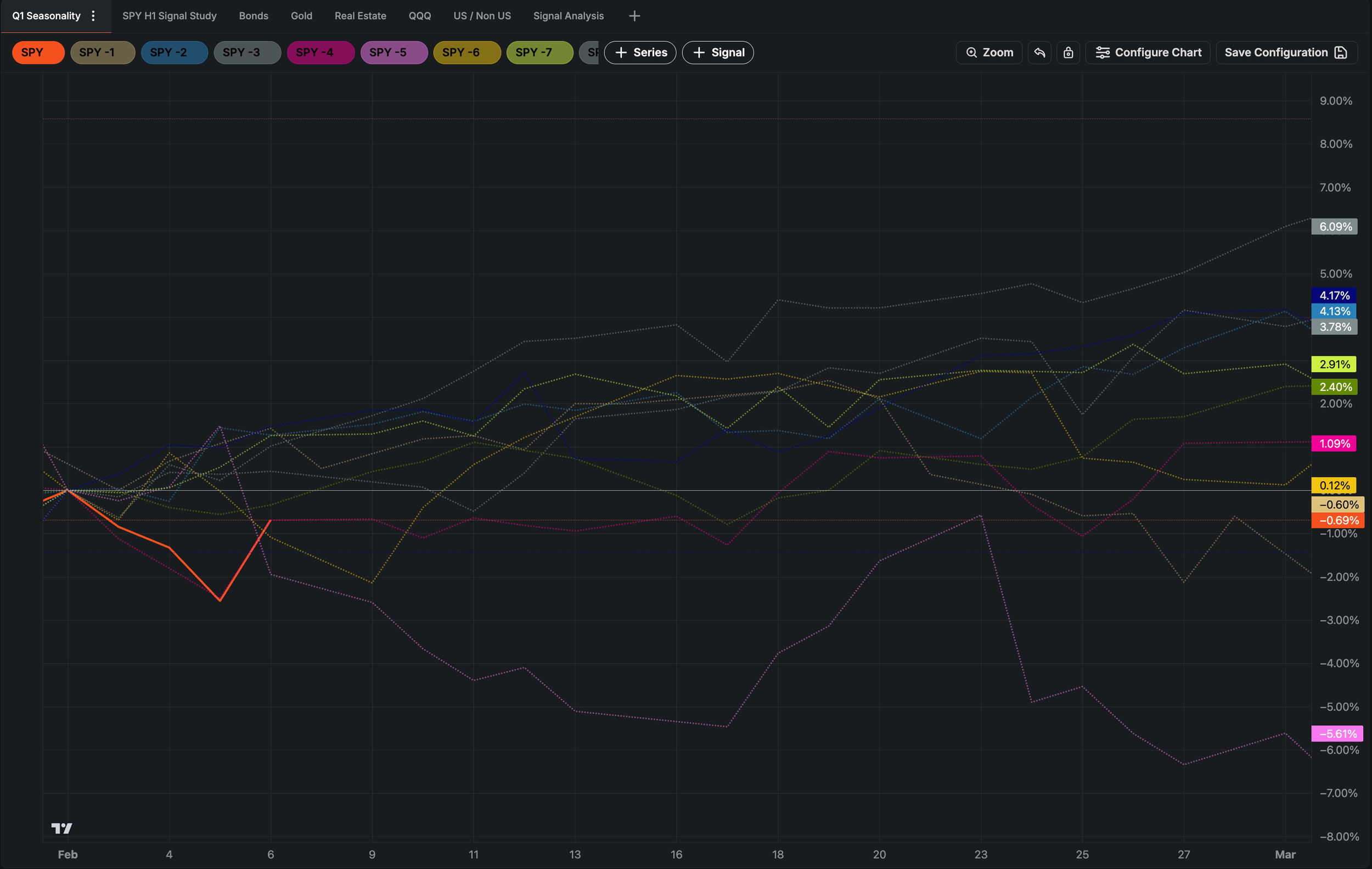
Markets started February on the back foot, as multiple asset classes declined or downright crashed last week. February tends to be a weak month by historical standards, with performance trailing the stronger gains typically seen in January and March. Fading seasonal tailwinds are now taking their toll: new-year fund flows begin to dry up, earnings announcements produce volatility and the retail-driven momentum of the holiday season loses steam.
Investors now appear to be in a more cautious mood, highlighting risks and factors such as policy uncertainty going forward. This is typically the case as February has a track record of chopping sideways or pulling back before spring’s broader recovery patterns take hold. Carson’s graph below is telling, as is also our seasonal chart.
The good news is that both the first 5 days of January, as well as the whole month were positive. The rest of the year has historically turned out to be positive as well when both of these signals align, as shown below. The average return for the year was +12.2%, with 87% of years positive!
With all eyes on high flying momentum and tech stocks, the price action from last week might feel like a train wreck. While it’s true that the Tech sector led the decline, a combination of de-risking across multiple asset classes tells a story that’s more linked to leverage and speculation rather than fundamentals.
Fundamentally speaking, earnings were very strong. Take Alphabet for example, which reported sales growth of 18% YoY to 113.8B and a an expanding gross margin at 59.79%. EBITDA grew to a record 42B in Q4, but a $50 billion AI capex spending plan shocked investors. The stock declined -6% in response. For context, capex as a percent of sales grew to 24.4% this quarter, versus 14.9% in Q1 2024.
Additionally, names like Amazon (AMZN) — also committed to a 200B capex spend — as well as CrowdStrike (CRWD), Salesforce (CRM), and ServiceNow (NOW) were hit as investors trimmed exposure to high-multiple names.
The combined performance of major AI related names heavily underperformed SPY on the month, with a -13.2% total return and a -32% current drawdown from all-time-highs. The liquidation across the technology sector was brutal and is likely far more extreme than forward expectations for growth and earnings justify.
However, other areas of the market did just fine. Capital simply rotated from tech to value (IVE). Energy, Staples, Financials, and Industrials outperformed on a relative basis, and even small and mid-caps held up better. The push into value stocks has now become grossly extended and buying tech on the dip becomes the contrarian play.
XLK is now showing a -6% 3-Month relative return to SPY, a historically low deviation which has usually preceded large gains over the following quarters. While sentiment in the sector is clearly suffering for a host of reasons (including valuation concerns as well as fears software SaaS is being upended by AI) — such periods represent a “reset” and not a “crash”. The longer term backdrop remains unchanged in our view.
The macro backdrop did not provide reasons for optimism either. The Fed is now sidelined, and labor data was mixed. There were fewer jobless claims and strong job openings, but ADP showed only 22K job gains in January.
Analyzing at the headline indexes on the week - it looks like not much has changed. The price action unfolded in the following way, as leverage started to unwind: crypto was hit first, then metals, then equities. It’s important to understand the sequence of these events. Gold and silver plunged after a series of CME margin increases were implemented in response to extreme volatility. Rising margin requirements compelled traders to free up cash to meet margin calls, and the quickest way to do that was by selling liquid holdings. That selling pressure took out Bitcoin, where leveraged long positions were aggressively liquidated as price cut through technical support around $65,000. Equities then declined as cross-asset risk reduction took hold. The move appeared mechanical rather than driven by sentiment or fundamentals.
On Friday, buyers again “bought the dip”, pusing SPY back up above initial resistance at $685 (M-Trend and 50-DMA). Technically, the bull market is alive and well. Support held at the end of the week and most of what got sold was eventually re-bought at a quick pace (including metals and crypto). While the selloff was sharp, there are probably more “trapped longs” looking to exit metals.
Media headlines were quick to point out various reasons why selling was so broad across multiple asset classes, but the most likely answer lays with systematic flows and risk-parity strategies reducing exposure.
Decliners dollar volume hit levels associated with temporary bottoms, as Thursday’s session showed signs of forced selling. These patterns align with margin-driven liquidation rather than discretionary positioning, especially since fundamental data that came out was solid. The rebound that we’ve seen on Friday will help ease selling pressure.
However, the risk of a second leg lower remains. Sustained upside requires volatility stabilization and tighter intraday ranges. Support needs to hold at the index level early in the week, so that further consolidation becomes the base case scenario. Failure at support will open the door to lower lows.
Our Trading Strategy (Sigma Portfolio)
The coming week will bring a heavy docket of economic data and earnings reports that could influence market direction, especially given last week’s vulnerable backdrop. Among macro catalysts, we note the BLS January Employment report, as well as CPI for January.
These inflation and wage measures will be closely scrutinized for clues on consumer demand, pricing measures and the Fed’s future rate path. Treasury auctions will continue throughout the week, which could influence bond yields and risk sentiment.
Among earnings reports, we’ll highlight Apollo Global Management, Becton Dickinson, Arch Capital Group, Cincinnati Financial, and ON Semiconductor. These could act as a barometer to how corporate America navigates slowing growth, cost pressures and capital allocation priorities.
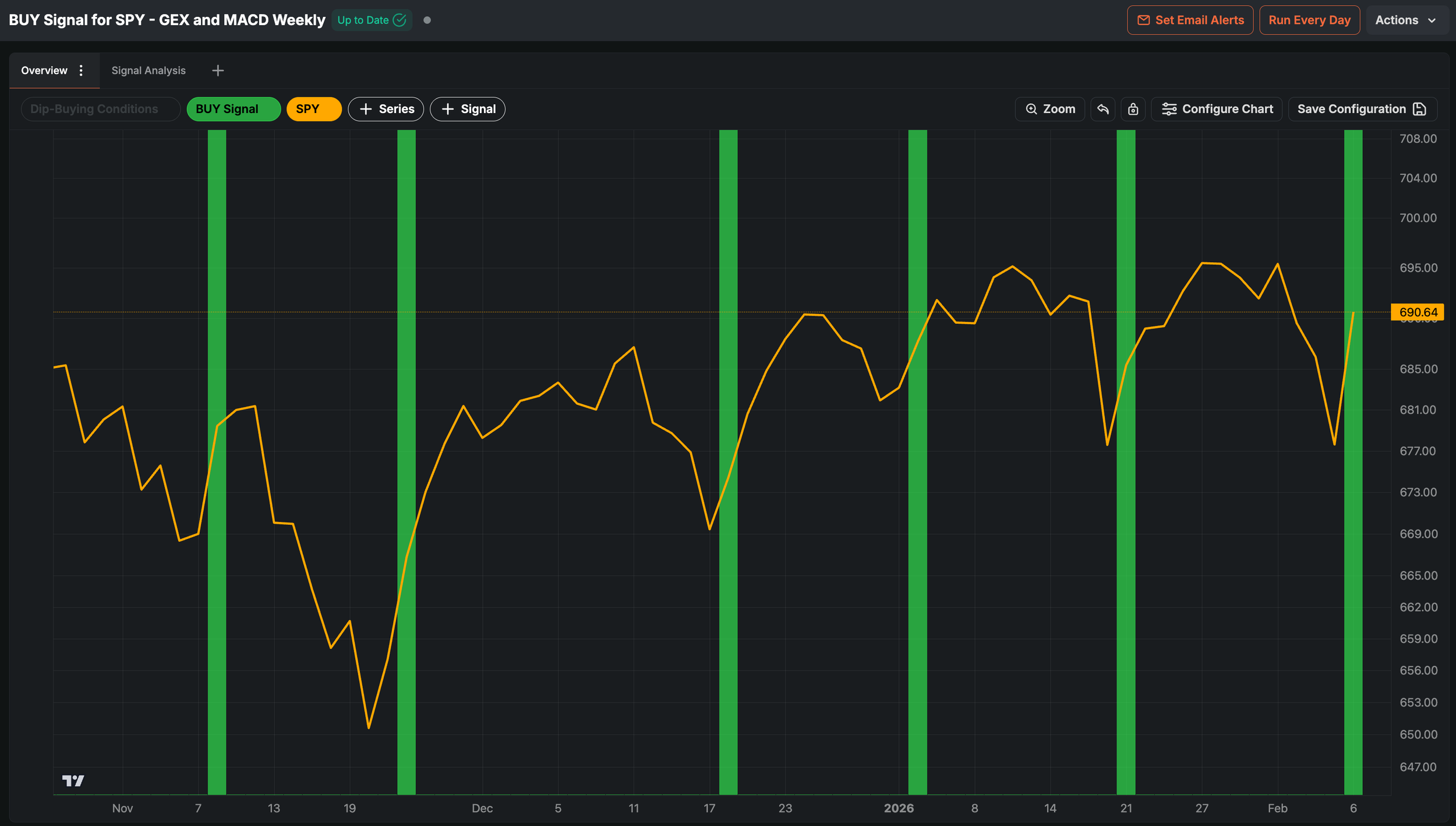
Sentiment still remains fragile after last week, and we’ll look for stabilization at current support levels. This week’s catalysts could swing market leadership and risk appetite. Fears in the Tech sector center around monetary policy, slower growth and high valuations. If investors start to price in higher discount rates, the present value of future profits can get re-rated fast. GEX flipped positive on Tech and one of our studies recorded a BUY signal due to the improvement in short term options positioning.
If conditions successfully stabilize, we’ll be looking to add to our tech exposure at this juncture, while simultaneously rotating out of value related stocks. If we were holding Energy or Industrial names, we’d probably be taking some profits. After all, tech is the leading sector that produces earnings growth, particularly in the semiconductor industry.
Technology also has the highest number of companies issuing positive EPS guidance for the quarter. However, just for comparison, while Energy and Staples have been the big winners in early 2026, they are also posting negative earnings growth. The secular trends supporting tech earnings are nowhere near reversed, so we view the current setup as a buying opportunity.
Disclosures / Disclaimers: This is not a solicitation to buy, sell, or otherwise transact any stock or its derivatives. Nor should it be construed as an endorsement of any particular investment or opinion of the stock’s current or future price. To be clear, I do not encourage or recommend for anyone to follow my lead on this or any other stocks, since I may enter, exit, or reverse a position at any time without notice, regardless of the facts or perceived implications of this blog post. I currently do not own or plan to own any position, long or short, in the securities mentioned.
I am not a financial advisor licensed in the United States. Nor am I providing any recommendations, price targets, or opinions about valuation regarding the companies discussed herein. Any disclosures regarding my holdings are true as of the time this article is written, but subject to change without notice. I frequently trade my positions, often on an intraday basis. Thus, it is possible that I might be buying and/or selling the securities mentioned herein and/or its derivative at any time, regardless of (and possibly contrary to) the content of this blog post.
I undertake no responsibility to update my disclosures and they may therefore be inaccurate thereafter. Likewise, any opinions are as of the date of publication, and are subject to change without notice and may not be updated. I believe that the sources of information I use are accurate but there can be no assurance that they are. All investments carry the risk of loss and the securities mentioned herein may entail a high level of risk. Investors considering an investment should perform their own research and consult with a qualified investment professional.
I wrote this blog post myself, and it expresses my own opinions. I do not have a business relationship with any company whose stock is mentioned in this blog post. The information in this blog post is for informational purposes only and should not be regarded as investment advice or as a recommendation regarding any particular security or course of action.
The primary purpose of this blog post is to share industry expertise and research and receive feedback (confirmation / refutation) regarding my investment theses.