
/ May 25 / Weekly Preview
-
Monday:
N/A
---
Tuesday:
S&P/Case-Shiller Home Price YoY
---
Wednesday:
ADP Employment Change Weekly
---
Thursday:
Core PCE Price Index MoM (0.3% exp.)
Personal Income MoM (0.4% exp.)
Personal Spending MoM (0.5% exp.)
---
Friday:
N/A
-
Monday:
N/A
---
Tuesday:
AutoZone, Inc.
Zscaler, Inc.
---
Wednesday:
Marvell Technology, Inc.
Salesforce, Inc.
---
Thursday:
Costco Wholesale Corporation
Dell Technologies Inc.
---
Friday:
N/A
Knocking On New All-Time Highs
Got a question about the markets, your investments, or a topic you’d like us to discuss in an upcoming article? We read every message and may feature your question in our daily write-ups!
Email: andrei@signal-sigma.com
Follow & DM on X: @signal_sigma
Last week, the market opened in on the back foot and managed to finish at record highs. It was the 8’th consecutive winning week for the S&P 500, matching a period in late 2023, with the current rally now extending to +17.6% from the April lows. The Dow also recorded an all-time high, but it was the Russell 2000 which led the week with a +0.84% advance.
The week’s key moment was the swearing in of the ned Federal Reserve Chair, mr. Kevin Warsh. In the ceremony at the White House East Room, President Trump told the crowd, “I want Kevin to be totally independent. Don’t look at me, don’t look at anybody.” Warsh’s tone was oriented toward reform, which signaled a shift in Fed communication. Notably, Powell will stay on as governor.
As such, the bond market was focal point for investors during the week, with the 30-Year Treasury Yield hitting 5.19% on Tuesday, the highest reading since 2007. Then, the long end started normalizing, with the 10-Year settling back down to 4.54%. Lower oil prices and swirling rumours about an Iran deal helped cool inflation expectations.
However, the abrupt rise in yields sparked a 3 day sell-off through Wednesday. Sector leadership favored Transports (XTN) — as oil prices declined — followed by rate sensitive Utilities (XLU), defensive Healthcare (XLV) and Real Estate (XLRE). Communications (XLC) was the only losing sector by Friday. Staples (XLP) notably lagged, hit hard by Walmart’s Thursday guidance miss that sent shares down more than -6%.
The rotation into Health Care week was the first real sign that breadth might be broadening rather than narrowing. Momentum names also found their footing again, with the VIX settling below 17.
Technicals are set up nicely for a continued grind higher. SPY has closed above the retracement level of $743 (R1) and futures are positive after the Memorial Day weekend.
Along with improved breadth and a revitalization of the momentum trade in Asia, we may as well see higher highs ahead. We are now trading comfortably above all 3 key moving averages, in a typically bullish setup. Both the longer and medium trends remain intact, Dark Pools were in accumulation mode and GEX is firmly positive.
A clean break above $750 opens up the path to $760 in the immediate term, with upside to $796 by the end of June (or mid-July). The 20-DMA at $730 is the key downside support, with further bids expected to come in around $710 (M-Trend). Should the market decline that much (and for any reason), we would chalk it off as a buying opportunity rather than a regime change.
Additionally, there is enough “room to run”, as we’ve flagged in previous instances. Investor sentiment is simply neutral (AAII bears actually increased on the week). These are not conditions typically associated with short term peaks in the market. Furthermore, a bull market has never topped out for the year in the month of June, which is right around the corner.
The market has shown resilience during this brief drawdown episode. With breadth now back to healthy levels, we must assume this kind of resilience does not happen by accident. It happens when underlying earnings strength and liquidity conditions are firm enough to absorb meaningful macro stress)
The most important variables to watch this week continue to be yields (especially the 10 and 30 year maturities).
Friday marks the key release of the week, in the form of the April PCE Price Index (the Fed’s preferred inflation measure). The main question is whether the recent energy-price spike tied to the Iran situation has bled into core inflation or if the rest of the basket remained contained. Consensus expects roughly +0.2% month-over-month for both headline and core readings, but any core print above +0.3% would likely propel the 30-year yield higher and increase stock market correction risk.
Midweek data points add nuance: Tuesday’s Consumer Confidence report will be watched for signs of further softening after three months of declines, while Wednesday brings New Home Sales and the 5-year Treasury auction as a real-time gauge of demand at current yield levels.
Thursday is the busiest day, featuring the second estimate of first-quarter GDP (after a 2.0% advance print), weekly jobless claims, and Pending Home Sales, any of which could reinforce or challenge the slowdown narrative. This is also new Fed Chair Kevin Warsh’s first full week on the job, so any public comments he makes will be extra parsed for hints on his willingness to resist White House pressure for rate cuts. Markets are currently pricing no cuts through 2026 and possibly a hike in early 2027.
On the corporate side the earnings calendar has thinned considerably, but a handful of names still matter: Salesforce reports Wednesday after the close, Costco and Dell both report Thursday night.
Costco’s update on member traffic and ticket size will be especially telling after Walmart’s recent guidance scare, while Dell’s print and guidance could test the already shaky AI-capex narrative following Nvidia’s muted reaction. Overall the setup remains binary, with a hotter-than-expected PCE print carrying the clearest downside risk for bonds and stocks alike.
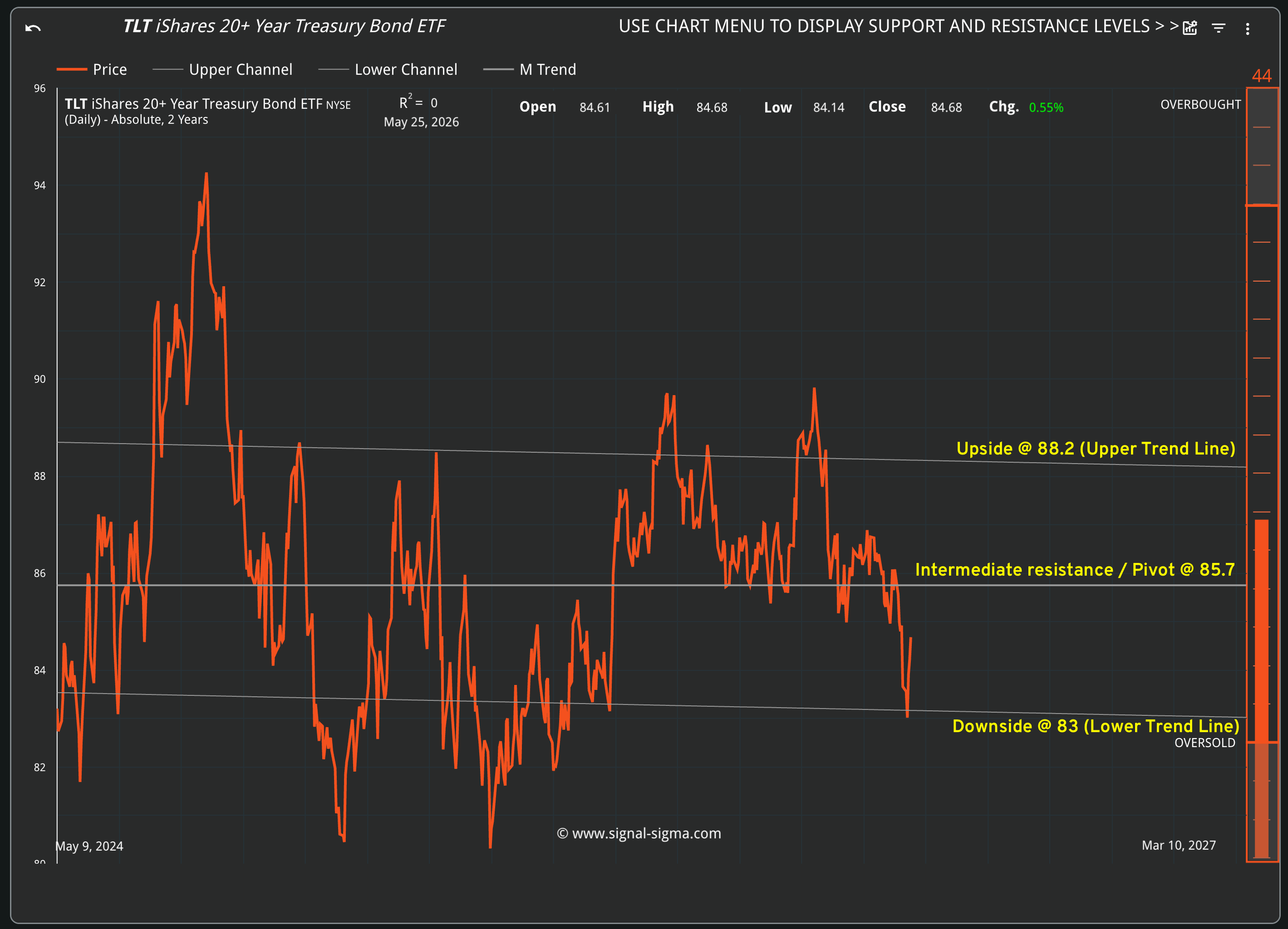
Long term bonds (TLT) have shown a remarkable jump following an aggressive decline, but it’s too soon to say whether this is a “dead cat” bounce or not.
In any case, the normalization of yields represents another “wall of worry” for the market to climb. Whenever an uninterrupted rally in SPY exceeded 17% (grey clusters in the subgraph), the resulting returns on a 3-12 Months horizon have been great (16%-20% annualized returns, with 90-100% positive return probability).
An uninterrupted rally of +17% was first established on May 13 on SPY.
Our Trading Strategy (Sigma Portfolio)
In conclusion, we’re quite optimistic on what the future holds for risk assets, pullbacks notwithstanding. The Enterprise asset allocation strategy is primarily allocated to equities. The Buying regime for SPY is active. Technicals and Market Breadth suggest resilience, earnings were better than expected and inflation provides a transient worry.
We are currently far from a situation where every positive outcome has been priced in. As such, we will use any pullback in client portfolios as an opportunity to get long this market.
In the Sigma Portfolio, we are already maxed out in terms of equity risk positioning, so we will only rebalance on a monthly basis. If (and when) trading conditions eventually become fully detached from fundamentals — as might be the case with the semiconductor trade — we will surely dial back our exposure and lock in gains.
Until then, it’s "full steam ahead”.
Disclosures / Disclaimers: This is not a solicitation to buy, sell, or otherwise transact any stock or its derivatives. Nor should it be construed as an endorsement of any particular investment or opinion of the stock’s current or future price. To be clear, I do not encourage or recommend for anyone to follow my lead on this or any other stocks, since I may enter, exit, or reverse a position at any time without notice, regardless of the facts or perceived implications of this blog post. I currently do not own or plan to own any position, long or short, in the securities mentioned.
I am not a financial advisor licensed in the United States. Nor am I providing any recommendations, price targets, or opinions about valuation regarding the companies discussed herein. Any disclosures regarding my holdings are true as of the time this article is written, but subject to change without notice. I frequently trade my positions, often on an intraday basis. Thus, it is possible that I might be buying and/or selling the securities mentioned herein and/or its derivative at any time, regardless of (and possibly contrary to) the content of this blog post.
I undertake no responsibility to update my disclosures and they may therefore be inaccurate thereafter. Likewise, any opinions are as of the date of publication, and are subject to change without notice and may not be updated. I believe that the sources of information I use are accurate but there can be no assurance that they are. All investments carry the risk of loss and the securities mentioned herein may entail a high level of risk. Investors considering an investment should perform their own research and consult with a qualified investment professional.
I wrote this blog post myself, and it expresses my own opinions. I do not have a business relationship with any company whose stock is mentioned in this blog post. The information in this blog post is for informational purposes only and should not be regarded as investment advice or as a recommendation regarding any particular security or course of action.
The primary purpose of this blog post is to share industry expertise and research and receive feedback (confirmation / refutation) regarding my investment theses.